SMILE Pro for High Myopia: Which Eye Measurements Determine Eligibility?
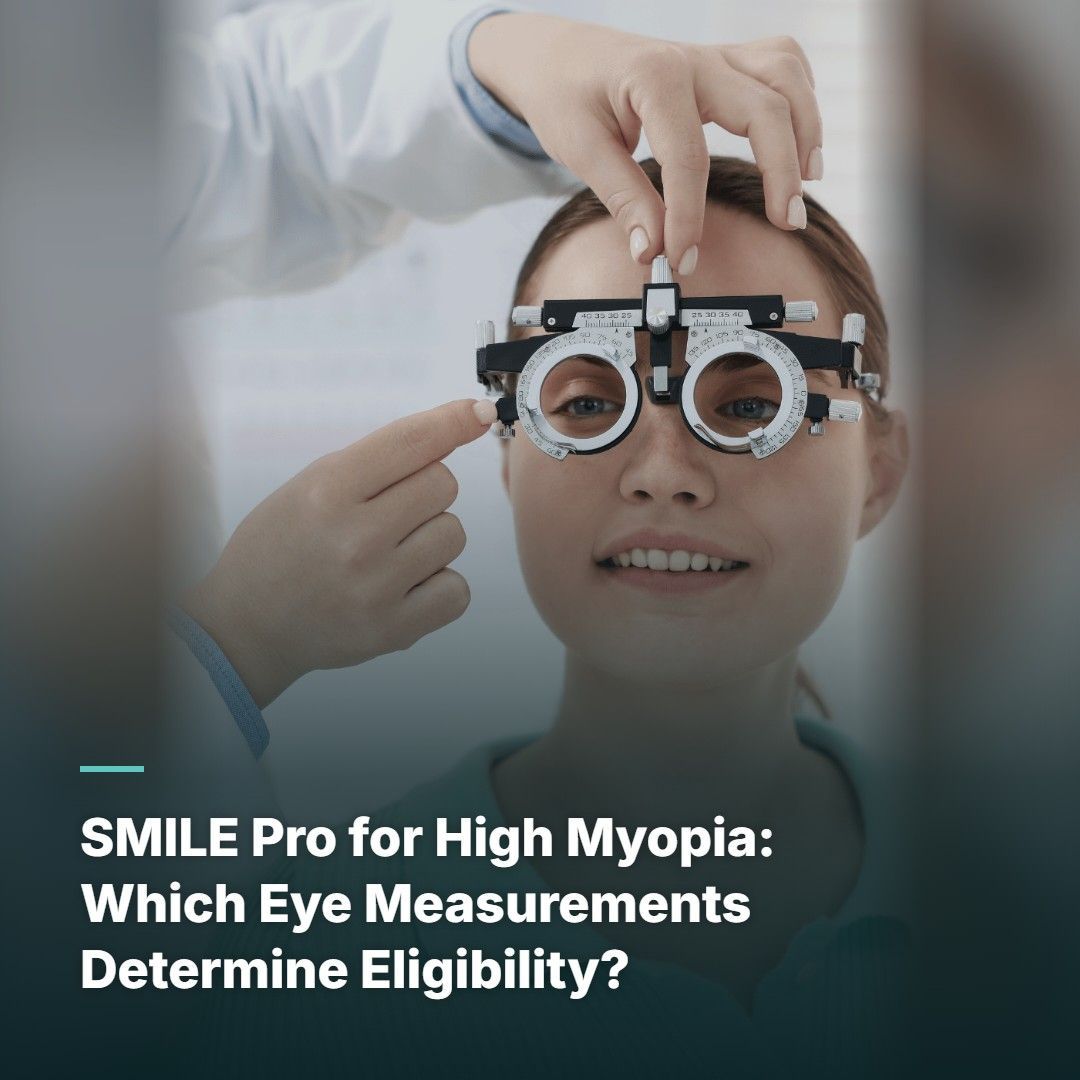
People with strong nearsightedness often have the most to gain from vision correction, but they also need the most careful screening. With SMILE Pro, eligibility for high myopia comes down to one central question: can your cornea safely give up the amount of tissue that your correction requires, while staying strong for life?
At a glance
- Higher prescriptions need thicker lenticules.
- Corneal thickness and shape are central to eligibility.
- An ICL is often considered when corneal limits are reached.
01 What counts as high myopia
High myopia is commonly described as a prescription of around -6.00 dioptres or stronger. At these levels, glasses can be thick and heavy, and many people rely on contact lenses for daily life. The wish for freedom from both is completely understandable. At the same time, a highly myopic eye is usually longer than average and needs a more thorough assessment, both of the cornea and of the retina, before any surgery is planned. It is worth asking how your own numbers compare with the clinic's typical candidates.
02 Why the prescription changes the calculation
The amount of tissue removed in SMILE increases with the strength of the correction and with the size of the treatment zone. A mild correction needs only a thin lenticule; a high correction needs a considerably thicker one. Since the cornea's long-term strength depends partly on how much tissue remains, surgeons must balance the size of the correction against stability. This trade-off is at the heart of every high-myopia consultation. This is why two people with the same prescription can receive different advice.
03 Corneal thickness and remaining tissue
Pachymetry measures how thick your cornea is across its surface. From this, the surgeon estimates how much tissue will remain beneath the treatment once the lenticule is removed. Clinics follow safety thresholds for remaining stromal thickness and for the proportion of tissue altered. If your numbers fall outside those limits, the correction might be reduced, the optical zone adjusted, or a different procedure recommended altogether. Your surgeon should be able to show you the calculated remaining thickness for your plan.
04 Checking corneal strength with tomography
A thick cornea is not automatically a strong one. Topography maps the front surface curvature, while tomography adds the back surface and the pattern of thickness across the cornea. Together they help detect subtle irregularities that may indicate a predisposition to ectasia, a weakening and bulging of the cornea. Suspicious findings usually rule out corneal laser surgery, regardless of how much thickness appears to be available. A second opinion can be helpful if your maps fall into a grey zone.
05 Pupil size and optical zone
Larger treatment zones help reduce halos and glare in dim light, but they require more tissue removal, particularly at high corrections. In high myopia, surgeons may need to balance optical zone size against tissue preservation. Your dim-light pupil size helps explain this trade-off and what it might mean for night driving. Ask your surgeon which optical zone is planned and why it suits your measurements. Night driving needs and work demands are useful to mention at this stage.
06 Prescription stability
Highly myopic eyes are more likely to have changed in recent years, particularly in younger adults. Surgeons look for a stable prescription over at least a year or two before treating, because correcting a moving target can lead to regression. Old glasses prescriptions are useful evidence, so bring them along. If stability is uncertain, waiting a little longer is usually the wiser decision. Steady measurements across two visits give the surgeon more confidence.
07 The retina matters too
A longer myopic eye has a thinner, more stretched retina, with a higher lifetime risk of tears and detachment. A dilated retinal exam is therefore part of screening, whichever procedure you choose. Any weak areas may be treated before surgery. Importantly, vision correction changes focus but not eye length, so regular retinal check-ups remain important long after your vision has been corrected. Ask how often you should have retinal checks after any procedure.
08 When an ICL may be the better choice
If corneal measurements make SMILE Pro unsuitable for your level of myopia, an implantable collamer lens is often discussed. An ICL adds a lens inside the eye rather than removing corneal tissue, so it depends on different measurements, such as the depth of the front chamber and corneal endothelial cell count. A good consultation explains clearly why one option is preferred for your particular eyes. Both options can work well when the right eye is matched to the right procedure.
The bottom line
For high myopia, eligibility for SMILE Pro depends far more on your corneal measurements than on the prescription alone. Ask to see your numbers and understand the safety margins before deciding.
This article is for general information only and does not replace an examination or personal advice from a qualified ophthalmologist.