What Is Topography-Guided LASIK, and How Is the Corneal Map Used?
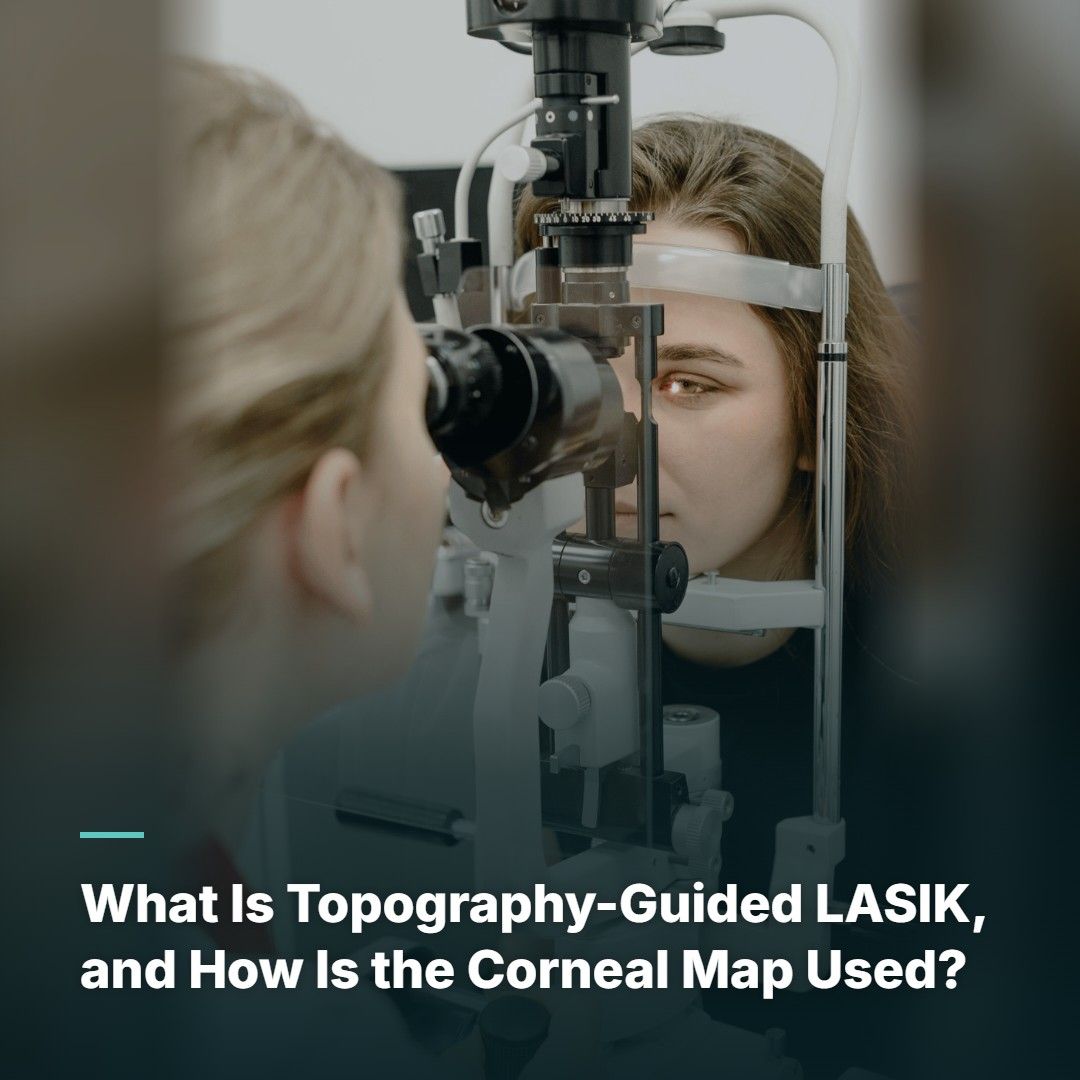
Topography-guided LASIK tailors the laser treatment to the shape of your cornea rather than only to your glasses prescription. It uses a detailed map of the corneal surface to smooth out irregularities while correcting refractive error. For the right eyes it can improve the quality of vision, not just the numbers on the chart.
At a glance
- A topographer maps thousands of points on the cornea.
- The laser plans a treatment specific to your corneal shape.
- It requires consistent, high-quality scans.
01 What a topography map shows
Corneal topography measures surface curvature point by point and displays it as a colour-coded map. Steeper areas usually appear in warmer colours and flatter areas in cooler ones. Regular astigmatism typically shows up as a symmetrical bow-tie pattern. Irregularities appear as asymmetric shapes or localised steep spots that a standard prescription does not capture. The pattern often tells a surgeon more than any single number on the printout. Colour scales differ between devices, so your surgeon will interpret the map in context. A red area alone does not mean something is wrong.
02 Why corneal shape matters
Two eyes with identical glasses prescriptions can have very different corneal shapes. Small irregularities may not appear in a standard refraction but can still affect vision quality, especially at night. Addressing the corneal shape as well as the prescription is the main aim of topography-guided treatment. People who complain of glare or ghosting despite good glasses sometimes have irregularities like these. These subtle effects often explain why some people feel their vision is not quite crisp despite an accurate prescription. Customised treatment tries to address exactly that.
03 From map to laser profile
Several scans are captured and the most reliable data is exported to the excimer laser. The treatment is designed to normalise the cornea's shape while correcting the prescription. Systems such as Contoura Vision on the WaveLight platform use this approach, and other manufacturers offer similar options. Planning software then checks that the profile stays within safe tissue limits for your cornea. The surgeon reviews the exported data carefully before approving it. Poor-quality scans are repeated rather than used.
04 Who may benefit
Candidates may include people with mild corneal irregularity, a mismatch between corneal and glasses astigmatism, or decentred treatments from previous surgery. For very regular corneas, results may be similar to well-planned standard treatments. The benefit therefore depends on what your own maps show. Your surgeon should explain exactly which features on your map justify a customised approach. Your surgeon may compare the expected benefit with a standard profile before recommending it. That comparison should be shared with you.
05 The planning skill involved
When the astigmatism measured on the cornea differs from the astigmatism in your glasses, the surgeon must decide how to reconcile the two. This judgement is a central part of topography-guided planning and one reason surgeon experience matters so much. Ask how often the surgeon performs topography-guided treatments and what outcomes they typically see. It also explains why outcomes can differ between clinics using the same laser. Planning philosophy matters.
06 What it cannot do
Topography guidance does not make an unsuitable cornea suitable. Keratoconus, ectasia, very thin corneas and unstable shapes generally remain reasons to avoid LASIK, whatever profile is used. Screening still comes first. If your maps show signs of weakness, the conversation should move to other options instead. Tomography and thickness mapping are still used to confirm safety. Customisation never replaces them.
07 Topography versus wavefront
Wavefront measures the optics of the whole eye, including the natural lens. Topography focuses on the cornea's front surface. Both have a role, and many surgeons choose based on which measurement is most reliable and relevant for a particular eye. Some clinics measure both and choose the approach that best fits each eye. In some cases the surgeon may use one to check the other. Consistency between them adds confidence.
08 Questions for your consultation
Ask what your topography shows, why customisation is recommended, how many scans were used and how your corneal astigmatism compares with your glasses prescription. Clear, specific answers help you judge whether the extra planning adds real value for you. Requesting copies of your maps is also useful if you want a second opinion. It is also fair to ask whether the customised option changes the price. Transparency helps you decide calmly.
The bottom line
Topography-guided LASIK uses the shape of your cornea to personalise treatment. It can be valuable for selected eyes, provided the cornea is healthy and planning is based on consistent, high-quality maps.
This article is for general information only and does not replace an examination or personal advice from a qualified ophthalmologist.